
1.4 billion
People living with hypertension worldwide
Around 1 in 6 people · 6 million in Taiwan
WHO Global Report on Hypertension 2023
CONNECTED HEALTH · BY RADIRAD
Fingertip sensing, AI waveform analysis and app-based tracking bring professional care from clinical settings into everyday life.
More than a billion people worldwide live with hypertension. Many remain above their blood pressure targets even with treatment, leaving them at continued risk of stroke, heart disease and premature death.
For decades, routine blood pressure monitoring has centered on cuff-based systolic and diastolic readings. Yet a single reading captures only one moment, and two numbers cannot fully describe pulse waveform shape or its changes. Understanding cardiovascular health calls for a broader view and ongoing tracking.
1.4 billion
Around 1 in 6 people · 6 million in Taiwan
WHO Global Report on Hypertension 2023
47%
Around 600 million people are unaware they have hypertension
WHO + NCD Risk Factor Collaboration
42%
Around 540 million people take medication without achieving control
JAMA 2023 · NHANES Data
SIGNALS INTO INSIGHT
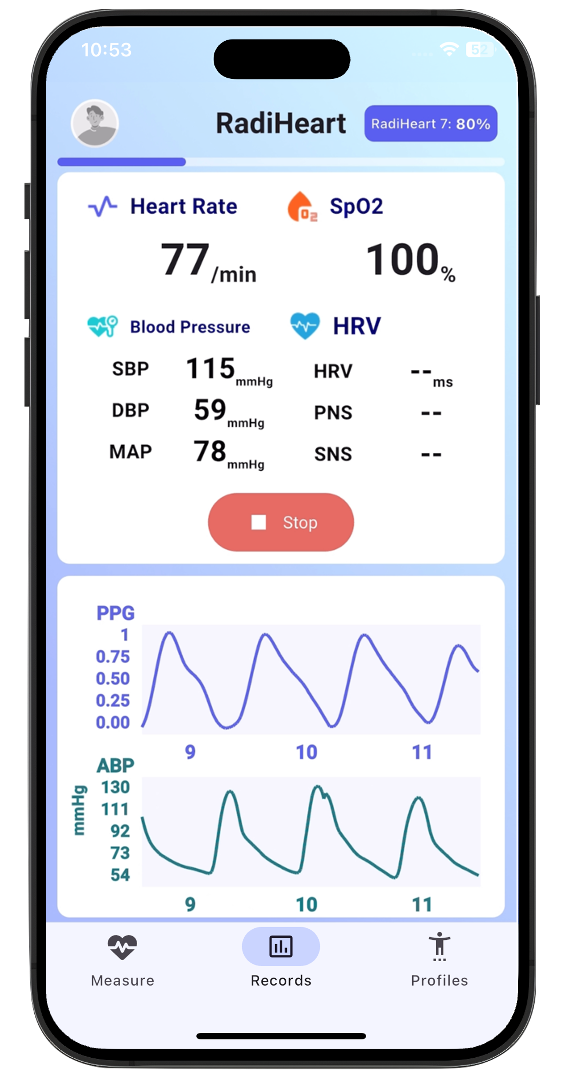
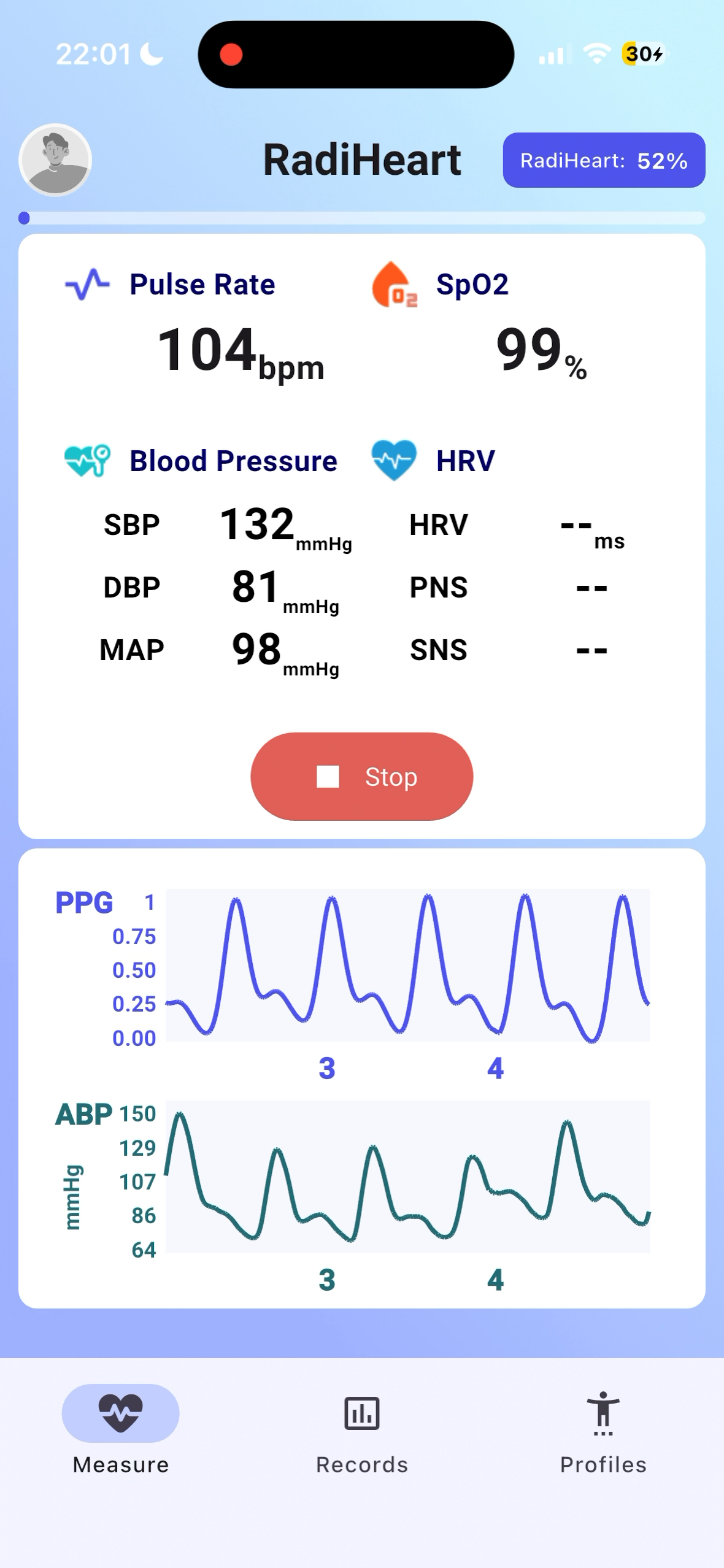
From basic measurements to advanced analysis, explore different aspects of physiological health. The app brings current results and past records together, making individual readings and long-term changes easier to understand.
An important measure of blood oxygenation, providing information for respiratory assessment and cardiopulmonary care while helping track changes in oxygen levels.
Oxygen saturation
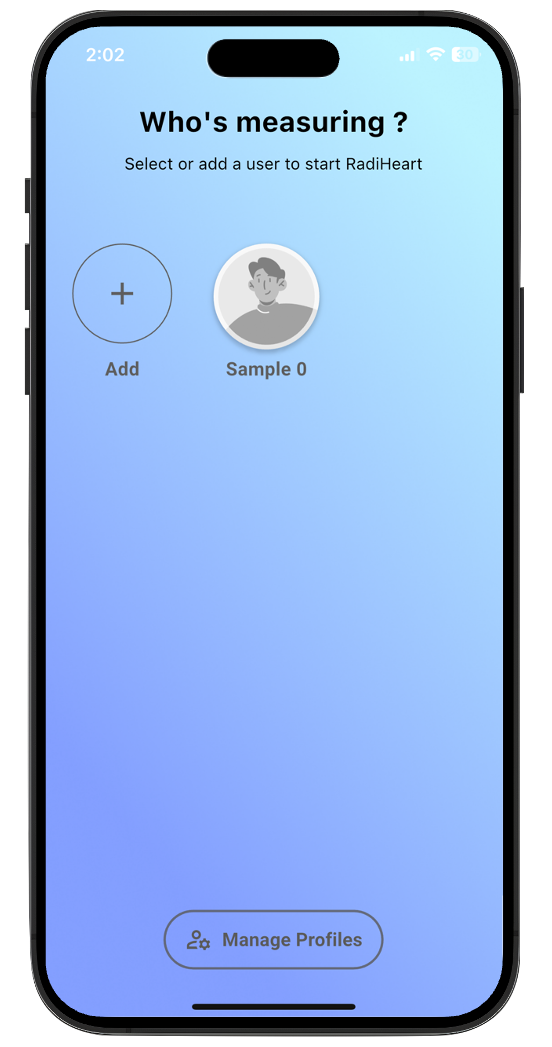
App screens are captured from the operating video. Values are demonstration data.
FROM FINGERTIP TO EVERYDAY
RECORDS OVER TIME
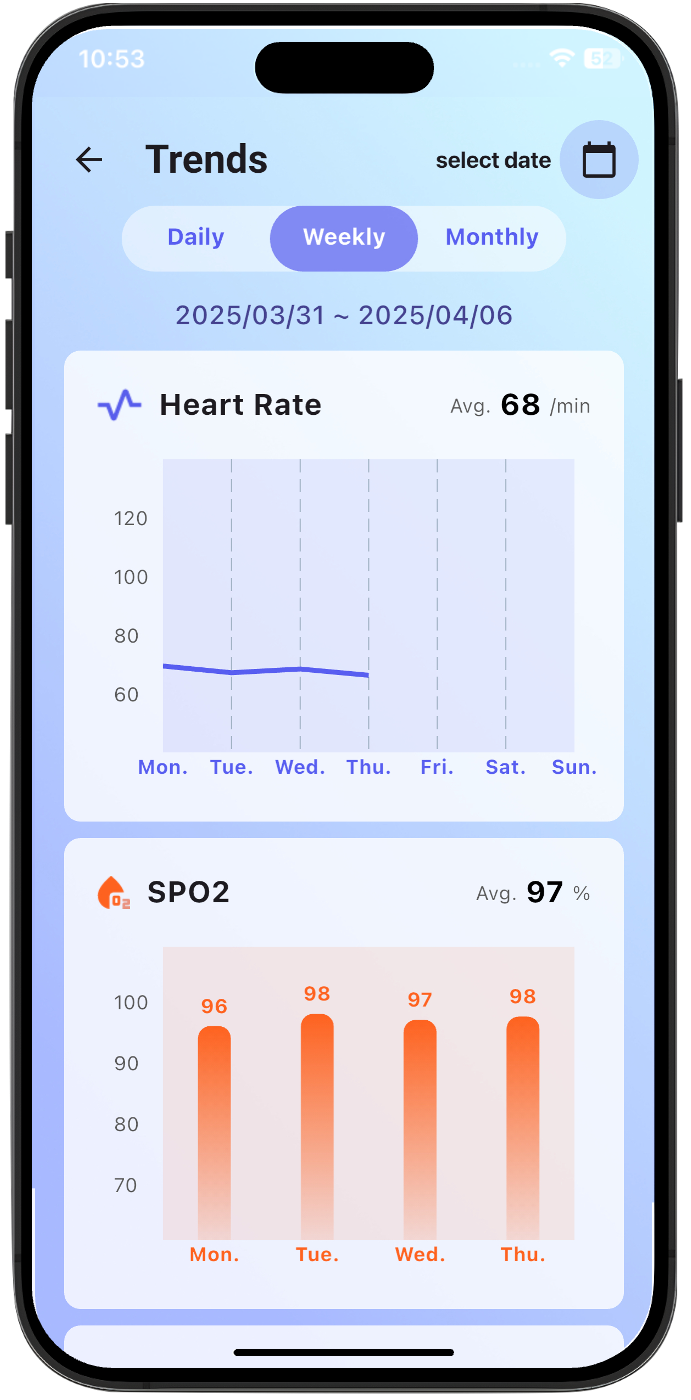
Review changes across different periods with trend charts, making each measurement part of a longer-term picture of health and care.
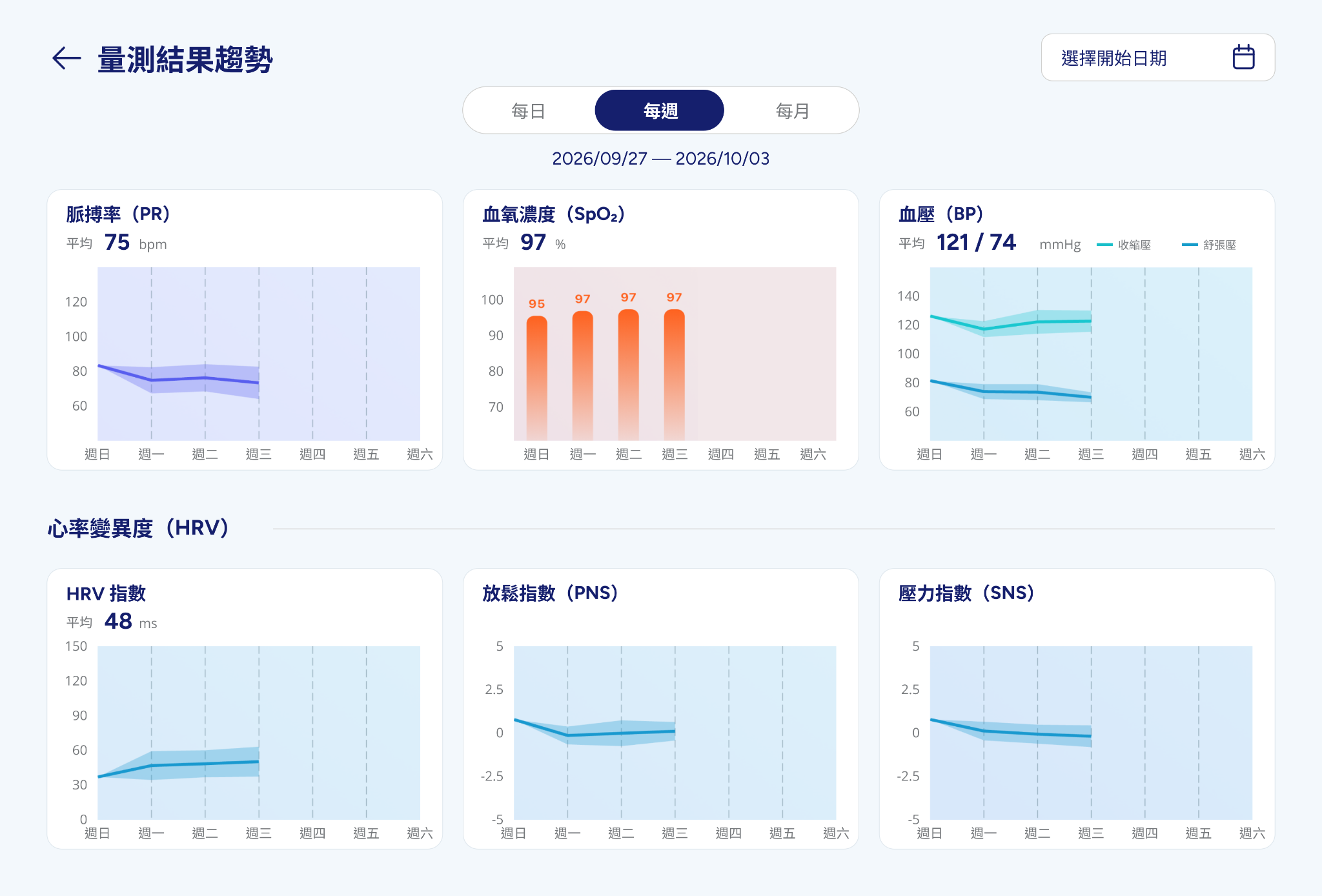
Illustrative measurement records.Swipe horizontally to view the full chart.
FROM SENSING TO ANALYSIS
Optical sensing captures fingertip photoplethysmography (PPG) signals. Signal quality control and AI waveform analysis then estimate the arterial blood pressure waveform, showing pressure changes throughout the cardiac cycle.
Optical sensing
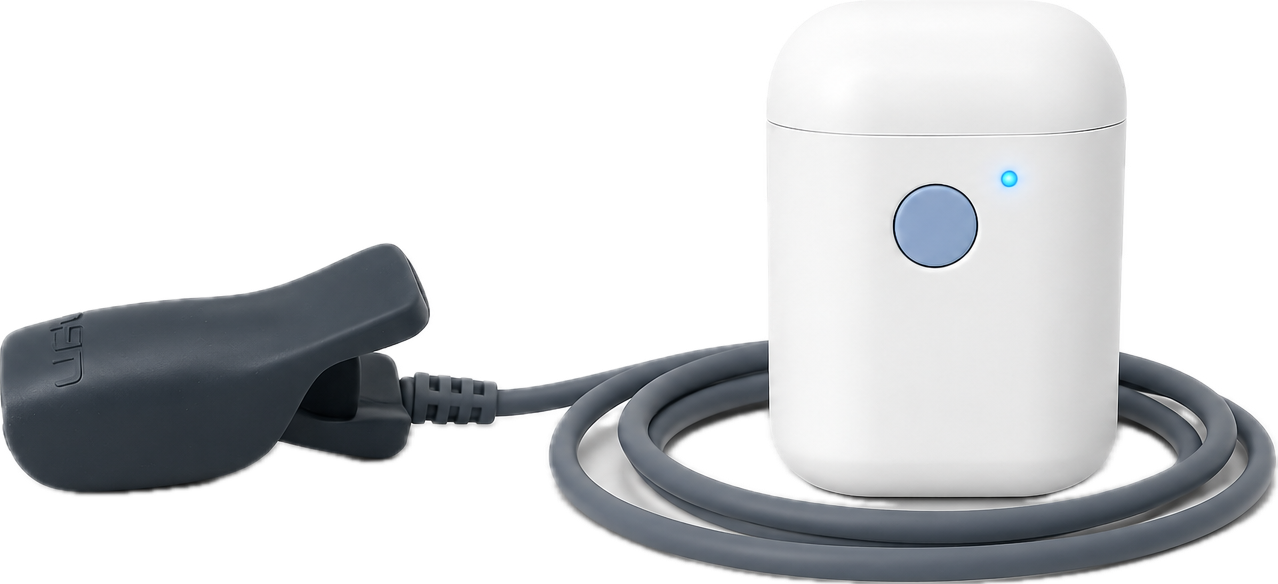
Red and infrared light capture fingertip pulse waves. A stable optical sensor and ambient-light rejection reduce interference from external light sources, preserving waveform detail and variation.
Signal processing
On-device filtering and signal-quality assessment reduce noise and select pulse signals that meet quality thresholds, providing reliable input for subsequent AI analysis.
AI analysis
Personalized deep learning models estimate arterial blood pressure waveforms from optical pulse signals and derive 32 cardiovascular indicators, revealing physiological information beyond systolic and diastolic pressure.
CLINICAL VALIDATION
Measurements from 111 participants at Hualien Tzu Chi Hospital were compared with a mercury sphygmomanometer to assess blood pressure measurement performance against ISO 81060-2:2018.
| Assessment criterion | Threshold | Systolic | Diastolic | Result |
|---|---|---|---|---|
| Mean errormmHg | ±5 | −2.10 | 2.44 | Met |
| Standard deviation of errormmHg | ≤8 | 6.20 | 5.82 | Met |
| Standard deviation of paired differencesmmHg | ≤6.62 / 6.51 | 6.60 | 6.35 | Met |
Validation summary provided by RadiRad.Study registration NCT06104501 ↗The registration link provides study information. The figures above are from the company's validation summary.
CARE WITHOUT THE DISTANCE
For healthcare professionals and individuals, bringing physiological information into more care settings.
FAQ
Find answers to common questions about RadiHeart, from personal use to adoption in healthcare settings.
RADIHEART PRODUCTS
Different sensing formats meet different needs, expanding physiological measurement and health tracking across professional care and everyday life.
From professional care to personal health management, we welcome opportunities in product adoption, international distribution and research collaboration, bringing physiological sensing and AI analysis to more real-world needs.
OUR PARTNERS